
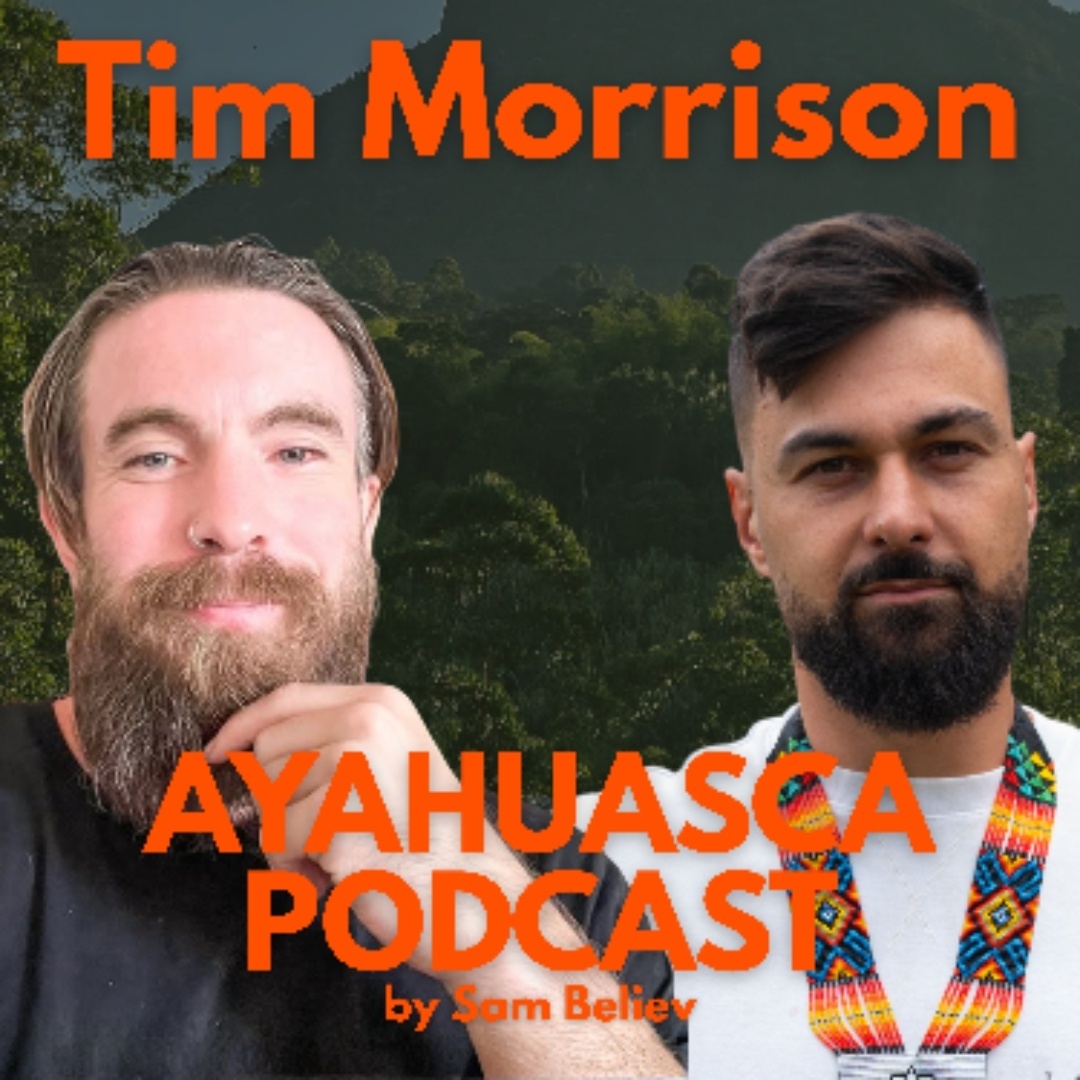
In this episode of Ayahuasca Podcast, host Sam Believ (founder of http://www.lawayra.com) has a conversation with , an Australian multi-instrumentalist, ceremonialist, and trauma-informed facilitator best known for his work in Spiritus Breathwork, somatic healing, and sound-based transformation. With over a decade of experience, Tim blends breath, movement, energy work, and music to guide deep healing and integration.
We touch upon topics of:
- Tim’s journey from elite Muay Thai fighter to healer after a life-altering injury (00:41–02:16)
- First Aya experiences, shamanic awakening, and long-term integration (02:16–03:46)
- Apprenticeship in the jungle and the origins of Spiritus Breathwork (04:16–06:41)
- Breathwork vs Aya: similarities, differences, and altered states (11:56–17:59)
- Trauma, nervous system regulation, and somatic healing (16:32–29:56)
- Dangers of spiritual bypassing and over-doing the work (30:05–34:01)
- Breathwork inside ceremony: grounding vs amplifying (34:15–38:47)
- Sound, music, and vibration as healing technologies (58:19–62:33)
If you would like to attend one of our Ayahuasca retreats go to http://www.lawayra.com
Find more about Tim Morrison on Instagram at @timmorrison__ or contact him at in**@**********on.com.
Transcript
Sam Believ: You’re listening to ayahuasca podcast.com.
Tim Morrison: The experience of the breathwork has changed something on a cellular level for them. I went into this huge what I’d call like a shamanic awakening where I had this Kundalini awakening, the dreams where I was like learning from spirits. I was hearing voices, seeing spirits, seeing energy.
When I started getting into this energy work, this is one of the things I was just like, man, what the . So part of this somatic work is helping somebody to build capacity within their system so they can feel more. This is a really big part of this, of the healing, is because when people don’t focus on the body or they’re not shifting what has been within the body, they just keep repeating the same thing over and over again.
And there’s no space to create something new for them because they’re so locked in these old ways of being. Everything you thought was real doesn’t feel real anymore, and your mind is completely open to like new concepts, new ideas. It’s easier to keep focusing on the past and not to become so aware of your unconscious thoughts and patterns in the present moment.
Through the quantum field, there’s like a, an immense amount of information, unlimited information, infinite possibilities and potential always existing in this space
Sam Believ: Hi, guys, and welcome to Ayahuasca Podcast. As always, with your host, Stan Beliaev. And today, I’m having a conversation with Tim Morrison. Tim Morrison is an acclaimed Australian multi-instrumentalist, ceremonialist, and a trauma-informed facilitator, best known for his visionary– his vision behind Spiritus Breathwork and somatic healing.
With over 10 years of experience integrating various healing modalities, Tim has dedicated his life to guiding transformative journeys through breath, sound, and movement. This episode is sponsored by LaWayra Ayahuasca Retreat. At LaWayra, we combine affordability, accessibility, and authenticity.
LaWayra, connect, heal, grow. Guys, I’m looking forward to hosting you. Tim, welcome to the show.
Tim Morrison: Awesome. Thanks for having me, brother.
Sam Believ: Tim your story is really cool, like the way you went to this line of work through pain and recovery. So tell us that story and the role Ayahuasca played in it.
Tim Morrison: Yeah, man. So before I was in this– in this work, I was like in the health and fitness scene, and I was personal trainer, strength and conditioning coach, all that kind of stuff. And I was also fighting at quite a, an elite level in, in Muay Thai and I- Yeah, I was I had just hit like Australian champ.
So I’d won a couple of titles for state and Australian championship, and then everything was going really well. And then one day I just woke up with an excruciating amount of pain. And I was actually in Bangkok at the time getting ready for a fight. And the whole left side of my body was shaking.
It was just like trembling. And long story short, I got my way home, but I had three discs that had popped out of my neck, and one of them had hit my spinal cord and jammed a nerve. And this had happened just overnight really, but they thought maybe it was just like microtrauma. But the more I kinda went into it, like later through the years, it’s kinda like maybe it’s a bit of a big slap from the universe.
It’s like you’re not doing what you’re meant to be doing kinda thing. But ended up getting… needing surgery to to fix it. And the surgery healed my arm, but it gave me nerve pain through the rest of my body, through like my back and stuff like that. And I hit like a really… Like it ended my fighting career, and it hit a really dark place.
I had a huge identity crisis. I didn’t wanna be here anymore. I didn’t know who I was all that kinda stuff. And I got to the point where I was just like, I just can’t keep living like this, and I didn’t wanna go to talk therapy or anything like that. Ended up finding my way into the jungle to drink Ayahuasca.
And my first trip, I went away for two and a half months. My dad actually came with me for… I think it was the first five weeks we were together. And we spent about a month together in the jungle drinking Ayahuasca, which was incredible, and had a huge healing not specifically around my neck, but around, different things that, that were happening before me.
And I came home everything was all good for a while. I was like, felt really elated, really really connected to myself, all the things. And then I went into this huge, what I’d call like a shamanic awakening, where I had this Kundalini awakening. This, all this energy was rushing through my body, shooting up my spine.
I was in and out of altered states of consciousness like daily. And this was… This went for about, five, six months. I was having dreams inside of dreams where I was like learning from spirits. I was hearing voices, seeing spirits, seeing energy, all that kind of stuff, man. I was just completely like really blown wide open with it all.
And it was a also a really dark time, and like I thought I was going crazy. It was like really intense. And my mom is a, a really amazing healer, and she went through something similar around the same age. So she really helped guide me through that, that, that period. And if it wasn’t for her, man, I def- definitely probably would’ve ended up in a hospital or something like that.
But we, So it took me about 18 months to fully integrate this first trip to the jungle and everything that had kinda happened. And then the moment that I felt everything integrate, I was meditating down at the beach, and I felt this this energy, this voice say to me “Now it’s time to get back to the jungle.
And if you go back to the jungle, it’s time to diet. And if you diet, your apprenticeship will begin.” And I didn’t really kn- know what that meant, but I knew that, I just needed to trust that calling. So I found a, a, a center in the jungle that was doing quite traditional dietas like with isolation and stuff like that.
And I went there, and as I went there, they offered me an apprenticeship to work with kambo and hapé and things like that to learn with them and to learn some other plant medicine stuff. And so I ended up staying at this place for probably about six and a half weeks just straight in the jungle.
And it was like ayahuasca one day, kambo the next day, ayahuasca, kambo the next day. And then I went to my dieta where I went 10 days in isolation in a tambu doing my first isolation dieta which was with uchus sango. And as I came out of that, I Was sitting in like a closing ceremony for the dieta with Ayahuasca, and I asked Ayahuasca “How can I bring this medicine back to my community without them having to drink Ayahuasca?”
And she said, “Let me show you, my dear.” And she put me flat down on my back, and she said, “Breathe with me.” And we began this conscious connected breathwork pattern. And I didn’t really understand breathwork that deeply at that, that time, so this was still quite new. I’d had experience with like Wim Hof and stuff like that, but n- nothing like this.
And it just flooded me with an immense amount of information about the breath, about the energetics the quantum stuff, all the things just like enmeshed into this big download of information. And so when I came out, I was just like, “Whoa, this is incredible.” So I was still in the jungle, so I’d practice every day on myself just doing this kind of breathwork.
When I got home, I practiced on my on my girlfriend at the time who’s now my wife on my friends, on clients, and then it just grew, and I got into doing groups and things like that. And then during this, this period I started really wanting to piece together everything that I’d learnt.
So I started to study with different modalities and teachings and really trying to grasp everything together. And during this time of this big awakening for myself, I went into this deep surrender with spirit, and I just said, “Hey, if you teach me how to get through what I’m going through, then I will spread this message with the world.”
And then it was just like this snowball effect of meeting different people, different teachers different mentors, working with different elders and things like that, that just really kinda taught me so many different pieces of the puzzle that I was, like, bringing together for myself that I ended up…
that I’m now teaching with people. And so this this style of breathwork that, that I teach is called Spiritist breathwork, but it’s a style of conscious connected breathwork, but it’s it’s like trauma-informed. It’s energetic sensitive. It takes into account like the somatic level, the emotional level, the, the mental shamanic, energetic and the quantum level all brought in together to create this experience for people to help them heal, transform, evolve, and not just look at the things that they wanna heal in their lives, but what are they wanting to create as well.
To step into a new vision for themself as well. So yeah, that’s a sh- that’s a short kinda intro into how I got here.
Sam Believ: Thanks for sharing, and congratulations on not giving up and just drinking or killing yourself, and actually using that pain- … and transmuting it into something very positive and helping other people as well.
Your story is definitely… probably scares a lot of people in dr- to drink Ayahuasca because they think “Oh, I’m gonna drink and I’m gonna get this- … shamanic awakening.” And of course it sounds scary. I don’t think it’s that common, e- except for people that are on that path. But you describe your mother going through something similar.
So basically, you’re like you- you’re like in a lineage in a way. … But,
Tim Morrison: yeah …
Sam Believ: did at any moment, did you just think “Oh my God I’m going crazy”?
Tim Morrison: Yeah, man, there was definitely times during it when I was like, “Man, I’m… Like, I’ve lost my mind. I’m going crazy.”
Yeah. And there was lots of moments of destabilization not knowing who I was, and a lot of fragmentation as well. And a lot of the journey was, like, getting stable to, to bring it all together, to integrate it. But it’s one of these things too, man, like the more I lo- look into it of that feeling like I’ve gone crazy, it’s like these, it’s whenever the ego, the foundation gets really shaken up or like starts to pierce through and then a new truth starts to come through, everything you thought was real doesn’t feel real anymore, and your mind is completely open to new concepts, new ideas. And I think that’s part of it as well.
And this is something that, you can see with people in breathwork too, is when they have that really core, especially if they come from somewhere s- like an area that’s been really dogmatic or a life that’s been really dogmatic, like it’s one way of being and no other way every other way is evil kind of thing, and they get that foundation shaken up they can have that moment of being like, “Oh, what is actually real?”
But for me that’s such a beautiful place to be because that’s like we can really seed in a new intention of like what are you wanting to create for yourself? Who are you wanting to be? And not having to fall by the wayside of of the old self, of how you once were before.
Sam Believ: So it’s it’s really cool how you describe basically getting a download of this specific style of breathwork from Ayahuasca.
I have an, I have a similar story where in the jungle I was drinking the medicine, and it was showing me how to heal people with my hands, and I was like- … “That’s cool.” And then I was describing it like six months later to, to a guy, and he’s “That’s Reiki.” “That’s-” I’m like, “Really?”
He’s like, “You’re describing Reiki one-to-one.” I’m like that’s interesting.” So it’s like knowing that there’s this some kind of information cloud, collective unconscious, something like that, that you can access and get information. That’s why there’s like repeating patterns of similar things around the world.
I don’t know if you have any opinions about that or if you have since had some other downloads.
Tim Morrison: No, man, like a… That’s exactly what I see and what I’ve learned, man. So through like the quantum field, there’s like a, an immense amount of information, unlimited information, infinite possibilities and potential always existing in this, in this space.
And when you attune to that and when you open yourself up to receive that information, which can be done through like deep meditation, breathwork, or plant medicine you can receive that information and it im- at- and it embeds into you as well. And this is some- one of the things that happens with Ayahuasca is these different realities or realms that you can travel to or you can connect to and receive that information.
Sam Believ: Yeah. I’ve had some ceremonies recently with that similar content, a lot of connection to just that, quantum field or s- like I do Joe Dispenza meditations as well. And I really connected to like non-linearity of time and how- … how, man- manifesting works as well on like a deeper level.
So Ayahuasca is definitely like very fast way to access those states. So- … for people who have never really done breathwork describe how is it different, the, those no ordinary states that you can access through Ayahuasca or through breathwork. How are they different? How are they similar?
Tim Morrison: There’s a few similarities that’s happening, say like within the brain and things like that happen.
And there’s quite a bit that’s very different as well. And it really depends on how strong the, the medicine is that you drink, right? But you could be in it for six to eight hours of just in that experience of really intense visionary experiences of like seeing fractals or colors, or you might go into like different realities or realms.
With with breathwork we’re working… you’re… With Ayahuasca, you’re drinking something, but with breathwork, it’s all endogenous that you’re creating. And it’s like a fine line because there’s no actual- Getting
Sam Believ: high on your own supply.
Tim Morrison: Yeah. Yeah. There’s no scientific study showing that you release DMT during breathwork, but it doesn’t mean that isn’t what happens either.
But there are some like brain shifts and oscillations within the brainwave patterns that are creating those altered states of consciousness that we can see. And one is something called transient hypofrontality, which is the prefrontal cortex starts to deactivate or loses like blood activation to it, which allows more blood activation to come more into the limbic region of the brain, which kinda lights it up.
And there’s like neuro disinhibition, so there’s a lot of the, the brains that are active for like executive functioning, things like that start to, to shut down too, and it’s opening up these gates to these stored memories, like the implicit memories of the body which is opening up these stored pathways of emotions and things like that.
But when we’re breathing in this way, there’s als- also a change in the carbon dioxide and oxygen within the level within our levels. So our pH levels are shifting and changing, and we get something called like hypercapnia and and respiratory alkalosis. And this is when we experience that we also, we’re also shifting the brainwave patterns as well, and we’re experiencing like these altered states of consciousness.
So when we’re breathing in this way, we are having these like physiological responses to it, but there’s also like these energetic layers that are coming as well. And so when we’re breathing in a rhythmic way in a conscious, connected way and this breath that we’re doing is in and out. So some breathworks are like out, things like that.
Or it’s one, two, then out, one, two, and out. This is like a rhythmic, cyclic flow. It’s also creating coherence within the system within the brain and within the within the, the brainwave patterns where everything’s like aligning as well. And it’s also depends on how how scientific you want me to get, but there’s like these cr- the cranial sutures in the brain will start to open and close like very subtly as this cerebral blood flow starts to pump up through the body from this cyclic flow of the breath, right?
So cerebral blood, cerebrospinal fluid is always moving through that spinal column, but with the breath, it’s moving it more through. We invite a bit more movement through the body too through spiritus. And so when there’s this shift within the pelvic bowl, when it’s like tilting, there’s like a posterior anterior shift that’s happening, helps to pump up the cerebrospinal blood flow fluid up into the brain.
And this is going up into that third ventricle where there’s a pineal gland and there’s piezoelectric crystals on that pineal gland. When they compress, it sends out signals, and they have this like DMT-like effect that’s happening through there as well. So these are like these, these altered states that, that are happening.
But when we’re doing it we’re going into these like deep states and like you can see this like through like the Joe Dispenza stuff when you go into this state of nothingness, no one, no time, no space, all that kind of stuff. We can experience that same thing through breathwork. But for me, with, with breathwork, it’s- For me i- it’s seeing like what is the intention of somebody that they’re coming in for a breathwork.
Are they wanting to heal their trauma and regulate their nervous system, or they want to have more altered states experience? Because they need a safe body to come back to after they go into these altered states of consciousness. And if somebody is always chasing these altered states of consciousness and they come into breathwork just to keep chasing that, then we may be affirming their own dysregulation or their own default defensive pattern where they’re trying to escape what they’re feeling within their body.
And they’re not accessing that trueness of that space out there. But when we work with the body to heal the body, to let the tension move from the body, and then we go into these altered states, there’s a much deeper and expanded state that people experience of healing and transformation in that way as well.
And so when we’re in this way, like they’ll, they will see these brain shifts that happen and sensations and symptoms that are similar to a a psilocybin journey as well. And then when they’re in this state where and these brainwave patterns are all shifting, they’re also opening up to this state of that nothingness, of that no time, no space, and into these complete visionary experiences where you can…
it’s very common for people to experience people that have passed over or having f- visions of their future self or things of the past and coming out having this life-changing experience where, the f- the, the experience of the breathwork has changed something on a cellular level for them.
They can’t put their finger on it, but they’re no longer the same person as they were when they began the breathwork. And again, like breathwork is really powerful, but it’s not for everyone. So there’s, a, a bunch of contraindications that would, you rule somebody out from doing breathwork, and people need to be aware of that as well.
So there’s certain things that would, stop somebody from doing a really deep breathwork journey. But there’s so many pathways in, into healing, and there’s so many ways that people can go about it to to experience these altered states of consciousness not just plant medicine, not just breathwork, but there’s, many different ways to get into trance.
Sam Believ: Is there is there any way you could give us a short, little, tiny sample, like of for people that are listening, obviously if they don’t have the contraindications and if they’re not driving or standing on the edge of the cliff?
Tim Morrison: Yeah, s- yes. So like a full journey would be an hour or just over an hour.
So we could all just do 10 breaths, cyclic breaths right now, and they could have a sense of that. But to really get into that altered state of consciousness, you’d be needing to do it like for at least five or more minutes.
Sam Believ: Like a two-minute one. Can you guide us through just to give people a little glimpse just to get them interested?
Tim Morrison: Yeah, cool. Let’s do it.
Sam Believ: Yeah. I’ll do it as well.
Tim Morrison: All right. So this breath as we breathe is just breathing in through the mouth, out through the mouth, and you’re breathing in with a relaxed jaw. So you’re breathing in with the words like, like you’re saying ah as you breathe in, ah, and out with a ha.
Yeah. And the breath goes from the belly all the way up into the heart space. So breath comes to the belly first, haaa, up into the heart, and then relaxing out, haaa. Yeah. Breathing in from the belly, haaa. Heart, haaa. Out, haaa. Then make it cyclic. Make it rhythmic all the way up in, haaa, and out, haaa. Good, and keep that flow in, haaa, and out, haaa.
In, haaa, and out, haaa. Good. And keep that flow. In and out. In and out. And just closing down the eyes and breathing in and out, and breathing in and out. Breathing in and out. Breathing in and out. Breathing in and out. And stay on that flow. Breathing in and out. In and out. And as you’re breathing, just allowing yourself to open with each breath, expand with each breath, and deepen into the body with each breath.
Feeling your body soften as you expand. And just letting go of any tension or tightness within the body. Just allowing yourself to go within. Staying with that breath, breathing in and out. In and out. So go deeper. Allow to fully expand as deep as you can. Haaa, and out. Haaa. In- And out. In, and now go 10 more breaths.
So it’s 10. We stay with it. In, and out. Eight more. In, and out. In, and out.
In, and out. Last five. In, and out. In, and out. In,
and out. Last two. In, and out. One more. Breathing all the way in, and out.
Just come back into nasal breathing and breathing in through the nose
Exhaling out through the mouth
It might have started to feel… Just stay with that breath of breathing in through the nose of four, out of the mouth for eight, just to slow the system down. But you might have started to feel your body start to get tingly, you start to feel a bit lightheaded or a little bit dizzy or even elevated And it’s really easy to shift our state using our breath And so when we look at using the breath, we look at using the breath, one, as this therapeutic way of using as a form of healing, of of transformation, evolution, helping the nervous system discharge all of the, the stored survival stress which isn’t meant to be like these long breathwork sessions.
They’re meant to be done like daily. Like you can do them like daily for a week as like a, an intensive, but you wouldn’t wanna be doing them all the time. And then we’re looking at like corrective breathing through functional breathing, where we’re learning how to breathe in an optimal way that is there for vitality and things like that.
Sam Believ: It’s really nice. So I definitely felt different changed my state a little bit more relaxed now, more, more embodied. And it’s what you say, right? It’s like the this you can shift your state literally by just breathing for two minutes. And I think it’s something Wim Hof talks about.
It’s like if you you might be super anxious or depressed and you might do something that you regret, but like just remember that j- just two minutes away from you is always that different state that you can access. I think it’s really cool for people to know and and practice.
Yeah. For me when I was trying to meditate, I could never meditate. I was like, my mind was al- would always be… But then I tried doing like couple sets of those like 40 breaths and then holding your breath and then trying to meditate, and it’s like-
…
Sam Believ: You can do it. So what are your thoughts on that?
Tim Morrison: Yeah, it’s one of those ways to really quiet down the monkey mind really quickly. So for those, for people that do find it hard to meditate, you can do, 10, 20 breaths and then take a deep breath in, hold it, exhale all the way out and hold it. Do that a couple of times. Some people just need it once.
You might need to do it a couple times. But it starts to really quiet down that, that monkey mind, and you can drop into that space really easy. But the thing for me, man is figuring out why it’s hard for somebody to meditate from that point. So if we’re needing the breath to get into it then there’s a reason, there’s a reason why the mind isn’t able to focus, so we need to address that part as well.
Not to say that you can’t do the breath before the meditation, but why is the reason that you need need that? I- is it hard for you to focus? Is it hard for you to find that place of presence? ‘Cause these are all tools of bringing us back to ourselves, right? So if we’re not always using them as tools but more as crutches, then that becomes out of a…
becomes more of an issue, right? We’re starting to just reaffirm the same dysregulation or default mechanisms that we’re trying to break through from as well. But there’s, other ways of doing the breath too, man, of when you, like your focus is to go really deep into a breath into a meditation where say take Joe Dispenza meditations.
So at the start he would do what’s like a, He’ll do like heart coherence first, breathing with the heart coherence, and then he’ll go into drawing up energy from the base up into squeezing all the way up and shooting it up into the pineal gland, and exhaling it out, and then coming sometimes into into heart-brain coherence and then into a deep meditation.
And that’s if that’s the intention, then that’s like powerful for it. So for me, it’s always what’s the intention for it, right? If that is part of what the work is, then that’s what it is. But if we’re doing it because we can’t access it in any other ways, then maybe that’s– there’s a edge for us to work in that way as well.
But the breath is an amazing way to draw people really quickly into a meditation. And again, it’s it’s it’s changing brainwave patterns and it’s, shutting down. So for example, a lot of people could be like highly stressed, and they don’t know that they’re highly stressed.
They live in that life for so long that they believe it to be true. “This is just normal. I’m always like hypervigilant. I’m always looking around. I can never sit still. I’m always like hyper-focused,” things like this. So they’re like, “Oh, this is just normal for me. I’m always go.” And then they don’t actually realize that their brain is probably active acting from what we’d call survival brain, where it’s like this protective mechanism.
So we could look at the brain really basically through two primary functions. One is like this learning, thinking brain, which is all about being open, being connected. I can understand like compassionate. I can take in new information, and this is like what you’d call if you’re looking through polyvagal, like in that ventral vagal state.
Then we have the survival brain, which is when we’re very much in like a, in a protective mechanism and defensive mechanism, and most people are in that. And the survival brain will always trump this learning or thinking brain, right? It always trumps it because survival comes first for us. It’s a built-in mechanism.
So people can be living in the survival brain all the time, not realizing that they’re always operating from there. And then the simple act of breathing, say they want to do a meditation, they can’t meditate ’cause they’re just… Their body may be always trying to detect a threat, so then they don’t…
They’re not thinking it, but their body is picking up signals and cues from their environment that they can’t go inwards because they don’t feel safe within the body. And then the simple act of breathing or doing some form of breathwork, which helps to soften those defenses and helps them to regulate and come back into their center, now they’re open.
Now they’re able to connect. And this is one of the things that the, the heart brain, heart-brain coherence does or breathing in that way or doing a heart-brain coherent meditation is getting you into that state. Now I’m open to receive. And so this is what that breath can do, is to help shift us into that state.
Now we’re in this meditative state where I’m open You can’t drop into a meditative state if you’re in this survival or protective mechanism. The body would just grip on more. And this is one of the things that we look at when we’re doing breathwork through Spiritus is like pacing the breath and working with someone based on their individual needs or especially their capacity of what they can do, what they can handle, and not trying to force a release.
And so this is the thing that you can see with like catharsis and breathwork. Catharsis on one end can be very somewhat damaging or fragmenting for some people, but really healing for other people. And there’s a few things for this, like when it comes from force, when you’re trying to force somebody into it and their body’s not really prepared, then it can be that fragmentation, right?
It may look really cool on social media, but it’ll be really hard for them to integrate. Versus somebody being really open and softening, and then the catharsis comes from this discharge of immobilized or frozen energy that’s now moving through the system, and now it’s coming out in this big cathartic way.
That’s really healing for somebody because their energy is needing to move somewhere, and their body is ready, is open, and it’s not gripping on through that release. And so this
is like like what we look at with breathwork in that way.
Sam Believ: This episode is sponsored by LaWayra Ayahuasca Retreat. Most of LaWayra if you’ve been listening to this podcast for a while. Some of you might have already been to LaWayra before. For those who don’t know us yet, we started LaWayra four years ago.
At LaWayra, we combine authenticity, accessibility, and affordability. LaWayra is currently highest-rated Ayahuasca retreat in South America with more than seven hundred five-star reviews and an average rating of five stars. If you come to LaWayra, you’ll experience powerful, authentic ceremonies led by our indigenous shaman, Fernando, in a very beautiful venue just one hour south of Medellín, Colombia.
We’re surrounded by nature and have comforts like hot water, Wi-Fi. At LaWayra, our team has guided more than twenty-five hundred people through this life-changing transformation of Ayahuasca experience. At the same time, we keep it very affordable. So whether you’re coming for healing, clarity, or a deeper connection to yourself, LaWayra is the best choice.
If it is your first time drinking Ayahuasca, you will love our three and a half hour preparation course and integration support. All of that is included in price, as well as pickup from Medellín, accommodation, and Ayahuasca. Visit lawyra.com to book your retreat or learn more. LaWayra, connect, heal, grow.
L-A-W-A-Y-R-A.com. I think it’s important with any tool not to use it as a crutch and not to rely on it as a form of bypassing and just… it’s applies with breathwork, Ayahuasca, anything you do. It’s like- … you do it and then you understand why you do it and what you do with it and not just keep going over and over again.
And you said, it’s not recommended to do every day. One, one of the things that with like very extensive br- breathwork sessions is like there’s a part of me that’s like, “Oh,” if you get Too much CO2 or is it like gonna hurt you or is there any like dangers or is there some, is there such thing as too much breathwork?
Tim Morrison: Yeah, if you’re looking at a, say, conscious connected breathwork, that’s at, on a chemical level one of the things that is happening is hypercapnia and and respiratory alkalosis. And generally when we go into some form of respiratory alkalosis, it’s signaling to the body that the pH levels are way off.
And then so it’s it’s like a signals of danger into the system. But because it’s done in like in a, I guess in a regulated way with breathwork in, for a short amount of time, the body just starts to to stabilize. So that’s one of the things is like, not to say that breathwork is dangerous if you like do it every single day.
I would say the danger would be is that you start to… Like your– you tax your nervous system more than what it’s able to handle and you’re going past you’re going past its capacity and now it’s going from like a stress, like a eustress that helps the nervous system to grow and expand to going into distress and then it’s going into like shutdown or collapse because it’s in the, in that way or perhaps it’s too much traumatic material that comes up and we can only process so much at once, right?
And this is where people go into healing crises is, and you probably see this with people that wanna like just keep pushing it with plant medicine, man, and that is opening up so many different pathways to and portals to what their body or their nervous system can actually integrate in any given moment.
When we look at-
Sam Believ: Yeah, it’s like, Sorry, carry
Tim Morrison: on. So I was gonna say, when we look at breathwork in a functional setting we could look at people that over-breathe, and this is detrimental to our h- our health, right? So people that are naturally over-breathers and they’re breathing in primarily through, through the mouth.
And the carbon monoxide and oxygen isn’t like the, the gas exchange isn’t where it should be. And so they’re over-breathing they’re– and they could be, like, really sensitive to carbon dioxide, so they getting much more sensitive to emotional load to stress levels.
And so what they’ve found as well is people that are, like, chronic over-breathers will have a lot of health issues. There can be shifts and changes to their facial structure and how their face has developed. There’s even been, like cases and studies wh- where they’ve changed somebody from open mouth breathing to nasal breathing, and their jawline has completely shifted from being, like, tucked into their face to being, like, nice and strong through the jawline.
But there’s this is one of the main things is that when we talk about breathwork, they wanna be, on a day-to-day basis, they wanna be breathing less than breathing more. And so the less that you breathe, especially when it’s functional and optimal, that’s where you wanna be for for health.
When we’re doing breathwork in a therapeutic session, we’re very much over-breathing purely to create the state of that altered state experience for the healing and transformation. So they’re two ends of the spectrum that, that you’re looking at, and that’s why you don’t wanna be doing these deep breathwork sessions every single day.
Say we don’t do a retreat or a training, they’ll be breathing every single day in that way. But then I’ll be, then I’ll be saying, “Hey, you don’t need to do breathwork for a good couple months. Just let this integrate with what you’ve been working through.” When we do our, our six month– We’ve got our six month training at the moment, and at the moment they’re doing breathwork every week, that these deep breathworks.
But then there’ll be a big integration period for them to let that kind of settle into their system.
Sam Believ: Yeah. That makes a lot of sense. And what you describe with opening too many portals and people doing too many things at once it kinda, the analogy came to mind is shoving too much food into your mouth without chewing.
It’s like you’re just-
Tim Morrison: Yeah. Yeah …
Sam Believ: and then you can’t even swallow, and then you’re like, “That’s not a good place to be.” Yeah. What do you think about for you that breathwork, it came through the ceremony and you’re breathing in the ceremony. What do you think about breathwork in the ceremony?
Is there may be specific technique that can help someone connect with the medicine or if they’re connecting too deeply to bring it down a notch?
Tim Morrison: Yeah. Great question, man. Just a kinda side note, when– A really interesting thing was, We, and this is like a different medicine, right? But like Stanislav Grof who created who cr- created the holotropic breathwork, this is how he found out about this kind of breathwork was he was doing like his LSD-assisted psychotherapy and there was like an instance where like somebody began to like hyperventilate or breathe really fast as the LSD started to wear off and it brought the LSD experience back up.
And so he was like, “Oh wow, there’s something here within that.” That was like the birth of that where he started to realize like this connection between the breath, altered states, and these like psychedelic experiences. So but with Ayahuasca I think that’s definitely the thing. For me, one is learning to…
and it’s hard, man, because sometimes the medicine just wants to… There, there’s not much you can do once you’re in it. For me anyways, right? Or maybe the shaman can, sing an icaros to help bring the medicine down or maybe you need to do some breathing yourself, but sometimes you get so taken off sideways that it’s like hard to bring yourself back.
But one is learning how to down regulate your system and one would be using like a like a parasympathetic breath which is breathing in through the nose for four, long, slow, soft and silent out of the mouth for eight. Some people can’t exhale for eight which is fine, just do six seconds, but doing that is helping to shift out of a sympathetic state into a parasympathetic.
Some people need a slight pause between the inhale and the exhale and that will like, say if there’s a lot of energy in the system that can help to settle it down or to, to breathe it down. Or doing a box breathing breath which is breathing in for four, holding the breath for four, exhale for four, hold for four and you just repeat that through and that’s creating some stability, some some like coherence within the system as well.
And you can do that between four to six seconds. You can do it longer if you wanted to but it’s just, four to six seconds is that sweet spot to really create that balance point for you as well. For like increasing it if it’s coming off, I think, I don’t know, man, it’s two minds about it ’cause yeah, you could do some breathwork, some conscious connected breathwork to, to bring it in, and that’s like stuff that I was experimenting with when I was in the jungle of doing it.
But it was more of “Oh, cool, like how is this like connecting? If I breathe like this in this way, is this helping to bring up the medicine?” So it’s I- if it’s that and you’re exper- experimenting with that, then give it a, a try. But the other part is, if the medicine is coming down and you’re like, “No, I wanna be in it longer,” then that’s also something to look at.
Because this is again when we look at like trauma, one of the patterns that gets formed at a very young age from zero to 1.5 is this pattern called the leaving pattern, where they learn it’s safe to be outside of the body or to be disassociated than to be inside the body. But the gift of that is that these people c- that have experienced that pattern are able to connect to spirit very e- easily.
They can go into altered states very easily. But in breathwork or plant medicine, these people can keep chasing that because that’s where they feel safer, and they don’t feel safe in their body. And so in this instance, if the medicine is coming down and they go, “No, I wanna be back in there. I don’t wanna come back into my body.
I’m gonna breathe to get back in,” then that’s the part that you need to look at of being like, “Why don’t you wanna come home into your body? Why do you wanna stay in, in the medicine?” And this is something again that we address in breathwork because this happens for people in a breathwork session.
They will be really deep. They’ve gone really altered. They’re in like this big space where they feel like they’re back home in that spirit world, where they feel like an immense amount of love and connection and no other issues or problems around them. And then there, it’s time to come home back into their body, and they don’t wanna come back, and they will resist to come back into their body.
And that’s the pattern where you’re like, “All right, cool. So this is that leaving pattern playing out right now. And that’s what needs to be addressed.” So yeah, that’s my thoughts on that.
Sam Believ: You talk about, being out of the body, in the body. Obviously, I think in your practice there’s a lot of somatic focus, like bringing people back into their body.
Can you talk about this? What does it mean and-
Tim Morrison: Yeah, so-
Sam Believ: what is the practice like?
Tim Morrison: Cool. So for me, Ben, it’s all about building capacity, right? So having capacity to feel. So if we look at… So there’s a something called like a window of tolerance, right? And a window of tolerance is pretty much everything that we can tolerate in any given moment, and our nervous system will fluctuate.
So our sympathetic will go up and down, our parasympathetic will go up and down engage, disengage. Within this window of tolerance, we’re able to experience life we’re able to feel emotions or feel like a trigger without defaulting into an old default way of being. Outside of this window of tolerance, if we’re we’re in this hyperaroused state where we can get into panic, anxiety.
If we’re underneath then we go into hypoarousal where we get into… Sorry, where we get into shutdown, collapse, into freeze, depression, stuff like that. So- Part of this, this work is a lot of people have a really small window of tolerance. They can’t tolerate much within their body. As soon as they experience something like their nervous system isn’t resilient, there’s no flexibility.
It’s very short and very reactive. So if something small happens or they get a text or, there’s a, a, a huge population in the world right now that will find any reason to be triggered or offended by something, right? And so when we don’t have capacity, we don’t have understanding for other ways of being, other worldviews or how somebody else thinks, it’s always very much like self-centric.
This is how I am. So part of this somatic work is helping somebody to build capacity within their system so they can feel more, they can be present with more without defaulting into these old survival ways of thoughts or behaviors or coping mechanisms. And this is a really big part of this of the healing, is because when people don’t focus on the body or they’re not shifting what has been within the body, they just keep repeating the same thing over and over again.
And there’s no space to create something new for them because they’re so locked in these old ways of being. So this somatic work, when I’m talking about doing the breath and we’re breathing, we’re connecting to the body, part of that is to help them to stay– to, to be able to stay present with sensations as they arise within the system.
When we breathe in a conscious, connected way, our sensitivity to sensations increase. So we wanna be able to stay present with what is happening without disassociating, without trying to tense up or become rigid again. And this is where we need to bring in things like titration, where we’re slowly building up that amount of sensation in the system, or some pendulation where they’re moving between that tension or discomfort to a place that feels safe within the body and helping them to feel that within their body.
And this is allowing people to to be more of themselves, to, to, to be– to have more aliveness in their system. And so for me, it’s always about how do you know when the work is working for you? And so things that we do within a breathwork session needs to transfer into their waking life, into their actual life.
So if people are like ho- and this is something that I saw like early on when I was doing a lot of work in this like kind of neo-tantric field. It was very about emotional expression and catharsis, not a huge amount about containment. And the same people were coming back doing the same, repeating the same things, releasing exactly the same every single month.
And I was like, “Why are people– Why are they– Like, what’s not shifting for them? Let’s get curious about this.” Is this work actually working? They need to keep on doing the same thing. And this is when I started to learn about, cy- like trauma loops, like cycling emotions, all this kind of stuff.
And people can get stuck in this identity of this is how you heal, right? Rather than focusing on “I’ve done the work and now I’m here to live my life,” right? Now how do I wanna live my life? What do I wanna do? What do I wanna create? The relationship I wanna call in, where do I wanna live? What do I wanna experience on this earth?
We can get so focused on, “I need to do the work. What’s the next thing I need to heal?” Or, “This has come from my childhood,” or whatever the thing is. And that can hook us into the past continuously rather than focusing on the future. So this building the capacity, we’re able to stay present with who we are, with what we’re doing.
When something happens, ’cause life is always gonna happen, do we get triggered to a point where we disassociate or we shout or get into aggression or rage? Or are we able to stay present with what it is and address the situation and figure it out rather than, defaulting back? And for me, that’s a, a real big piece for people.
‘Cause a lot of people will wanna come and do– And this isn’t to say people who don’t have big breathwork sessions when they’re feeling in their body, they very much do. They’re still very altered, but it’s a very somatic experience for them. Sometimes they have a very somatic and very energetic and quantum experience at the same time as well, right?
Some people just have a very somatic and they don’t have this full energetic experience. So it’s different for each person, and this really depends on the pace of the breath, like the velocity of that breath and the amplitude of that breath, like the depth, the width, like how much breath is coming into the system.
It very much depends on that. It’s the same as drinking Ayahuasca, right? How streng- how, like how strong the the c- the, the medicine is, how much it’s been brewed, how thick it is, like the kind of vine that’s been used, like how old is the vine. It’s like all these different contributing factors of the strength of it.
The same with breathwork is like how the depth of the breath, the velocity of it, the amplitude, all the things shape how deep somebody’s journey is as well. For me, when I’ve been working with people and you can see the point where they start to disassociate from the sensations in their body, and they still have a really powerful experience in the altered state or say, like in the shamanic or energetic space.
But nothing has shifted for them in terms of how they feel sensation when they’re outside of a session. And so because these are so autonomic responses, it’s very built in. So these implicit memories are very much sensory based very procedural, things like that. It’s it’s hard for them to shift that, and then so they just keep repeating these same patterns outside of the space.
But when they’re able to address the body, that shifts also for them when they’re outside of the workshop or the breathwork space.
Sam Believ: Yeah, that makes a lot of sense. And people that keep coming back, like it also happens to us. It’s really good for business, right? Because they keep coming and spending money, but it’s not good for them personally sometimes.
Sometimes you need a lot to move through something, but eventually- Yeah … you need to ease off. But, And- … I think it’s about also this identity of seeker or identity that I’m- … I’m healing. But it’s like eventually you kinda just just have to make a decision that “Yeah I’m healed or at least healed for now or good enough.”
‘Cause if you’re a seeker, then you’re constantly seeking and where’s the end of the seeking?
Tim Morrison: 100%. And for me, what I say to people too is there’s always gonna be something. There’s… You’re always going to find something. If you’re looking for it, you’re gonna find it Do enough work to shift you out of where you were into who you’re becoming, right?
But don’t forget the real goal of it is that you’re human, that you’re here to experience life, and you experience the full range of the human emotional spectrum. But what do you wanna create for yourself? Do you wanna create a business? What do you wanna do? Because for a lot of people, creating a business shines a light on so many of your own insecurities, shadows, limitations, and that is the work in itself as well.
And so it’s shifting the focus on, “I need to heal the past,” to like, “What am I creating for the future? Who am I wanting to become?” And for a lot of people, that is– they become comfortable in the mud, but they become very resistant to the light, to this to the expanded self. And so that’s becomes the work.
It’s like, all right, you’ve done the work in the mud. Now come into the light. Now come into this expansion. Who are you choosing to become? And I think it’s easier to keep focusing on the past and not to become so aware of your unconscious thoughts and patterns in the present moment, and that’s where the real shift needs to happen, in these moments of unconscious reactions to present day stuff that’s happening.
And this is at the integration piece I feel a lot of people miss. And so they might come do plant medicine. They feel like, they come for a week, and they feel open, expanded. Same with breathwork. They feel completely different, and then they go home, and it’s the same thing or it’s the same relationship, and it’s reminding them of who they used to be, and then that in itself is pulling them back into that reality.
When really the work from that place, from that integration is when those triggers arise, consciously choosing not to go in that way or doing s- the somatic work to work through those default survival responses to create safety within the body. ‘Cause one of the things is if we still have this stored survival stress or we’re in a heightened state all the time, we’re still signaling to the body that we’re under a state of threat And then our state will also shift our thoughts too.
So then the way that our body is responding will shift how we think. But there’s never a time that our body doesn’t influence our mind, and there’s never a time that our mind doesn’t influence our body. So we need to work in tandem with them both together. But that integration piece, I think is so deeply missed in pretty much all areas of healing, is that they feel like the healing is in the moment of the retreat, of the medicine journey, of the breathwork, when really a lot of the healing comes in the integration of recognizing the triggers, breathing, becoming present, working with what is there, and choosing a new way, not defaulting back.
And it’s this this journey of overcoming the old self. And that can be the greatest fight for a lot of people, is overcoming the old self, ’cause it feels so familiar, it feels so known, that it takes a lot of work and dedication and devotion to shift out of that into who am I becoming? Who do I hang around with?
What kind of food do I eat? What do I drink? Where do I live? What is that vibration? What is this next level of me going to require of me? And can I do that? How do I do that? Let’s figure this out.
Sam Believ: Yeah. That definitely makes sense and yeah, like even understanding where it is you’re going, like what is that final destination?
So you manage- you mentioned energies and neo- neo-tantric approach. So what is the role of energy in all this? And how do you do it? ‘Cause I remember you, you saying that plants show you– showed you that, that level as well. So talk to us about that.
Tim Morrison: Yes. The way I see the energetic level, and this is like from s- stuff I was seeing, like with implant medicine.
So the other part I didn’t share, so a lot of this I was learning through Ayahuasca and then also when I was coming back to the jungle and went into the Andes as well, I was learning a lot through Wachuma as well. But also learning a lot about vibration and sound through, through mushrooms too. I learned a lot about sound through, through my mum she’s an incredible sound healer.
But like through plant medicine it was Ayahuasca the most. San Pedro was like locking in a lot of pieces, especially how to work with the body with sound with the breath, what to do. And the mushrooms were like like vibrational seeing like how sound works in this like this 12-day sphere of energy.
But I’ve also done a lot of study about the en- about energy, about energetic field, about, the quantum field and all that kind of stuff too. So it’s all like in together. But, so we all have an energetic field. We all have like a field, an information field, and we are like this blueprint of what this information field is is displaying, right?
So if there’s– if we have certain disease or injuries or illness is coming in through this, this field that’s moving in. So there needs to be some work that’s done around this energetic field to create, you know, newness around that energetic field so that we are creating a new state of wholeness or connection or love or health.
Then we have our, like our torus field, which is, like coming out through our body and it’s like a, a field that moves right around us and it’s like this cyclic cyclic field that’s moving through us as well. Then we have energy that’s also within the body so energy that’s moving from the spine from the base up into our crown.
So we have energy that’s moving up through there. And then we also have energy imprints or layers within our field, within our body. And so sometimes I’ll work on the energetic field outside of the body and sometimes the energy that I work with is extracting energy from somebody or there might be an energetic block that has– that is within somebody.
So for example, somebody might be breathing and the way I’m looking at their body breathing is through their head, through their chest their their rib cage, their stomach, their pelvis. How is that moving? Where is the energy stuck? Where isn’t there a, a flow of energy moving through?
And so for example, they might be breathing and there’s no– their base is moving their ribs are a little bit moving but their head isn’t moving so there’s some energetic block between like their heart space and their crown. And so I’ll feel in and then I’ll feel where the energetic block is and this energetic block can come from for example there might be somebody that has always closed down their throat, haven’t said what they wanted to say.
It might have just come from them bracing around emotional expression or whatever. And then I’ll find the energy within them and then I’ll extract it or just pull it out or twist it, pull it out and that will open it up and then their body will start to move in this way where there’s now an energetic flow moving through There’s also the– this energy that is like layering around the body, so you can use that energy with your hand to move it, to help move the body to create more flow and connection through the body as well.
So we’re looking within the body to see where there is connection, where is there disconnection, where do we need to breathe into or move into connect into to allow this body to, to to reconnect because the, the body is always wanting to rejuvenate, right? It’s like its natural state is to be in a state of healing, of love of connection.
So the body is wanting to get back into that, but we’re looking at how do we get the body back into that alignment. Like how– what is needed within that way as well. And so a lot of this body work, a lot of this like energy work had just– it just woke up within me. And when I went back to– So after it had woken up within me, I went back to the jungle and I worked with a different different teacher, and she got me to diet this, this plant called Sueracon Suerha.
And she was like, “This is gonna help you further your further your knowledge with healing with your hands.” And I had an incredible journey, like where I was seeing like the plant like move out of my hand and how to do kind of things with my hand as well. It was absolutely wild. But yeah, that’s what I’m looking at when I’m working with the energetic field as well.
And sometimes there’s also w- one of the things I’ve seen with people is either, And this has happened within breathwork sessions that haven’t been held by another facilitator and also people that have gone to plant medicine retreats that haven’t, They’ve been opened up but not worked with correctly.
They’ve had like entities attached to them in session, and this takes like another layer of of work to extract the entities that have attached to them. And then these entities that have attached to them are causing pain, they’re causing psychological issues. And then once they’re- they’ve gone, they’re no longer feeling that, that energy in their body, or they feel completely different within that as well.
And when I started getting into this energy work, this is one of the things where I was just like, “Man, what the fuck? This is wild, man.” And it was one of these ones where it’s happened so many times that it that it’s just true. Like it’s– it can’t be anything else other than what I’m experiencing as well.
So yeah, that’s how we, that’s how I kind of view, view the energy of it as well. And so we can, we can increase our own energetic amplitude as well. So some people have a really weak energetic field, and this is like why they, get, might get injured easier or they might get they might feel fatigued all the time.
Just have a really weak energetic amplitude or a really weak energy, energetic field. But we can build up that energetic field. We can put more energy into it, so then we actually become stronger energetically, and it’s less likely for, for things to enter into our field because we already have this like strong energetic field.
And one of the best ways for this is purely just through heart coherence, man is building up that heart coherent field that, that energetic field is… I would say like lately that’s pro- been like the, the best one I’ve seen or used to build up that energy field.
Sam Believ: Yeah. The, there’s all kinds of weird and interesting things when you go to those levels.
And I’ve seen some bizarre stuff as well, but it’s, that’s why it’s important to work with a shaman, with a plant medicine- … skilled shaman or in your case, skilled facilitator. Someone who knows, like if he’s opening up to something, they understand how to close you back. And if your soul leaves your body and goes somewhere, to like how to bring it back.
Yeah. So you you mentioned sound and you’re a musician, so there’ll be a last question. So what is what is the importance of sound? What is the importance of sound in Ayahuasca ceremony or a breathwork session?
Tim Morrison: The way we can look at sound is sound has its own vibration, it has its own intelligence. We can use sound as like healing, where it’s like where we’re using the vibrations to shift the state or the energetic field, or where there’s like incoherence or maybe some destabilized energy to say like with a singing bowl to bring that back into alignment.
And then we can see like sound journey, where we’re using sound as this way that’s going to create some brain entrainment that’s gonna help alter the state of consciousness that we can adj- we can align with that’s taking us on the journey and that, that sound is opening up parts of the body or the brain or the energetic field to open it up.
And then we can also combine the two together, and that’s really what within like Icaros, like when they’re singing the songs of the plants and we’re able to sing you into different states and to sing into your body and extract things and move things around and take you into those, those journeys.
And this is like this this experience of seeing h- especially like medicine work, you feel it the, the most is where you, y- you recognize that we’re neuroacoustic beings in terms of this sound is shifting us on a nervous system level where they might be singing and they’re like, there’s a bit of a bounce to it, a bit of like a like a, yeah, like a bounce to it and like your body is moving and tremoring to the sound that they’re singing through.
In breathwork is it’s similar, right? We, The way I was– Well, the way I use sound is to journey people and for healing in that way. So we use sound to, to activate people, to open people, to deepen them. You can use sound to really bring up the energy. So for example, like you’re…
i’m working in a group, we need a bit more kind of energy, I might bring the didge in, bit more faster pace, bring up the energy and drop them deeper in. The room erupts, a lot of you know, emotional release, needs a bit of calming. Let’s slow this down, might just play a little bit of guitar or maybe some soft nurturing singing to to slow it down, and it becomes like this journey with it as well.
So it’s what is the room, what are the people needing for that sound? And music is like this universal language for us all and there’s different rhythms that create different experiences, different frequencies that create different experiences. You could even use sound, in relation to the different chakra system if that’s how you want to do it as well.
But there’s so many different variations. But for me, like sound is is essential for a really powerful journey because it’s opening people up in that way too. When you’re doing, say, breathwork, And you’re just using Spotify, then you’re like needing to really understand the music that you’re doing, what are the words that are being sung or spoken in that song, and how is that impacting somebody as well and what’s the energy or the intention behind that song because that’s also what they’re receiving as well.
And you can see how that can also negatively impact somebody on the same way, right? And this is like where facilitation needs to be in a… It’s such a sacred act of service that, that we’re doing. And we’re using sound to, to deepen the experience, to calm them, to open them to expand them and to take them to where they need to go.
The sound can also create the empty space that’s required to drop them deeper into their experience so they feel engulfed by the sound, so then they’re within the frequency of the sound and they’re no longer in the space. Does that make sense? They’re like… the the sound is filling up the container for them and it’s also holding the space as well.
Sam Believ: Yeah. That makes sense to me ’cause I sing in a ceremony myself and there’s definitely not just singing. It’s like it’s a, it’s an act of energetic sort of like casting- … this protective net and trying to s- harmonize people through the singing. Yeah. Yeah. And yeah, I hope you come to LaWayra soon and I think you’re gonna love our ceremonial music.
It’s it’s very next level. Tim, thank you so much for this episode. I think it was very packed with information. I’ll definitely need to re-listen to it myself. Tell, tell the listeners more about where they can find you and more about your work.
Tim Morrison: Yeah. If you wanna find me, you can find me on Instagram on Tim Morrison, then two underscores.
If you wanna get in contact with me, you can send me an email to in**@**********on.com. Yeah, we send all of our events on Instagram, we put them on our website. We’re currently in Australia at the moment, but we’re due back into the States mid-April, May to probably June, and then we head over to Europe.
So we’re gonna be doing some events in America and Europe again next year. Currently right now we’re, we’re in a six-month online facilitator training, so the next one won’t be till next year. But we’ve got some in-person trainings that we’re gonna launch soon for next year as well.
So yeah, best is just to hit me up on Instagram or or email. But yeah.
Sam Believ: Thank you, Tim. Guys, you’ve been listening to Ayahuasca Podcast. As always, we’re your hosts Sam Belyev, and I’ll see you in the next episode. I hope you enjoyed this episode. If you’d like to support us and psychedelic renaissance at large, please follow us and leave us a wherever it is you’re listening.
Share this episode with someone who will benefit from this information. Nothing in this podcast is intended as medical advice, and it is for educational and entertainment purposes only. This episode is sponsored by LaWayra Ayahuasca Retreat. At LaWayra, we combine affordability, accessibility, and authenticity.
LaWayra, connect, heal, grow. Guys, I’m looking forward to hosting you